Sentry Password Protection Member Login

Student Login

Forgot? Show

Stay Logged In

My Profile

Javascript Required

Back to Tax School Homepage

Tax Topic 16 - Education Tax Credits, Scholarships and Fellowships


In this tax topic you will learn the the different tax treatment of various types of educational assistance. In addition, you will review the tax benefits that may be available to you if you are saving for or paying education costs for yourself or other students in your immediate family. In addition, you will also learn how and when to you can take business deductions for work-related education and the educational tax credits available to your for higher education.

Student Instructions:

Print this page, work on the questions and then submit test by mailing the answer sheet or by completing quiz online.

Instructions to submit quiz online successfully: Step-by-Step check list

Answer Sheet            Quiz Online

Most forms are in Adobe Acrobat PDF format. Get Adobe ReaderYou will need Adobe Reader to view and print these forms. If you do not already have Adobe Reader installed on your computer, you may download the software for free.

 

Use IRS Publication 970 to answer the following questions. You may also need Form 1040 Instructions.

Complete  Form 1040, Form 8863 for this topic.

Maria's family goes to school.

bullet Maria's daughter, Leticia Gonzalez,  paid $2,000 for tuition fees for herself to attend a qualifying community college full time. Leticia had expenses used to claim the Hope credit in the previous two years.
bullet Her son, Raul Gonzalez, also paid $1,800 tuition fees to attend the same community college full time. However, Raul only attended school for about a month, and he was not eligible for a refund of fees paid.
bullet Her children are her dependents and she claims them on her return.
bullet Leticia's SSN is 555-10-7500 and her date of birth January 20, 1990.
bullet Raul's SSN is 555-10-7501 and his date of birth February 20, 1991.
bullet This is the first year Raul attends college. Both Leticia and Raul are enrolled to pursue their degrees.
 

Maria is a not married. She provides a home for her son and daughter. She is the only one that can claim her children and provided for her family by herself. No one can claim her or her children as dependents.

She paid rent all year for a of $9,600.00.

Maria received a tax-free scholarship from Women for Education Inc. The amount she received was $3,000 towards her studies to get a nursing degree at the same community college her kids attend. All the money was for enrollment and attendance as specified by the school.

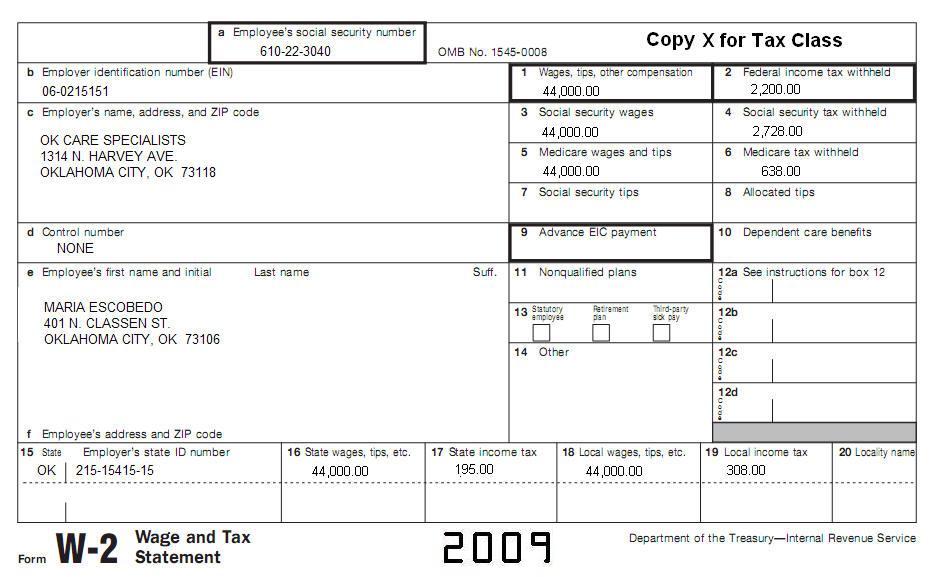
Get all basic information from the following W2, including income information.


1. Look at the Form 1040 you prepared for Maria Escobedo. What is the amount on Form 1040, Line 49?


A. $2,280.
B. $1,900.
C. $3,000. 
D. $0.

2. Look at the Form 1040 you prepared for Maria Escobedo. What is the amount on Form 1040, Line 66?


A. $2,200.
B. $1,520.
C. $0. 
D. $844.

3. For purposes of the Hope credit, qualified educational expenses are

A. Insurance, and medical expenses (including student health fees).
B. Tuition and certain related expenses required for or attendance at an eligible educational institution.
C. Room and board, transportation or similar personal, living, or family expenses.
D. All of the above.

4. To claim the Hope credit, the student for whom you pay qualified education expenses must be an eligible student. This is a student who

A. For at least one academic period beginning in 2009, the student was enrolled at least half-time in a program leading to a degree, certificate, or other recognized educational credential.
B. Had expenses that were used to figure a Hope credit in any 2 earlier tax years.
C. Has completed the first 2 years of postsecondary education (generally, the freshman and sophomore years in college) before 2009.
D. Was not free of any federal or state felony conviction for possessing or distributing a controlled substance as of the end of 2009.

5.  Larry and Lisa Sanchez are married and file a joint tax return. For 2009, they claim an exemption for their dependent daughter on their tax return. Their MAGI is $63,000. Their daughter is in her sophomore (second) year of studies at the local university (not in a Midwestern disaster area). Larry and Lisa paid qualified educational expenses of $5,700 for their daughter in 2009. Larry and Lisa, their daughter, and the local university meet all of the requirements for the Hope Credit. Their tax for the year was $5,536. 

A. Larry and Lisa can claim a $5,700 Hope credit in 2009.
B. Larry and Lisa can claim a $3,600 Hope credit in 2009.
C. Larry and Lisa can claim a $1,800 Hope credit in 2009.
D. Larry and Lisa can claim a $3,400 Hope credit in 2009.


6. The amount of the Hope credit for 2009 is

A. 100% o the $1,200 of qualified education expenses you paid for the eligible student.
B. 50% of the next $1,200 o qualified education expenses you paid for that student.
C. Both A and B above.
D. $2,400 for all students involved.

7. I you claim an exemption for a dependent who is an eligible student,

A. Only you can include any expenses you paid when figuring the amount of the Hope credit.
B. Only the dependent can include any expenses you paid when figuring the Hope credit.
C. No one can claim the expenses you paid in figuring the amount of the Hope credit because no double deduction is allowed.
D. None of the above.
 

8. For lifetime education credit, if you paid qualified higher education expenses with tax free funds, you cannot claim a credit for those amounts. A tax-free educational assistance would be:

A. Tax-free part of scholarships and fellowships.
B. Veteran's educational assistance and Pell grants.
C. Employer-provided educational assistance.
D. Any of the above.

9. Edna went to school in 2009. She is single and her MAGI is $52,850. She paid $3,500 for her tuition and books. Her tax is $7,455. What is the amount of the lifetime learning credit that she is entitled to.

A. $361 Lifetime Learning credit.
B. $955 Lifetime Learning credit.
C. $700 Lifetime Learning credit.
D. $1,800 Hope credit and $2,000 Lifetime Learning credit.

10. For lifetime education credit, this is an expense that would not qualify even if the amount must be paid to institution as a condition of enrollment or attendance.

A. Cost of transportation.
B. Tuition and certain related expenses required for enrollment in a course at an eligible educational institution.
C. Medical expenses (including student health fees).
D. Both A and C above.

11. If there are qualified education expenses for your dependent for a year, the lifetime learning credit can be claimed by

A. Your dependent can claim the lifetime credit, because she was the student.
B. You, because you paid the expenses and you are claiming the dependent's exemption.
C. Either of you, but not both of you, for your dependent's expenses for the year.
D. None of you.

12.  If, after you file your 2009, tax return, you or someone else receives tax-free educational assistance for, or a refund of, an expense you used to figure a Hope credit on that return, you may have to repay all or part of the credit. You must refigure your credit for 2009 as if the assistance or refund was received in 2009. You add the repayment to your tax liability

A. By filing an amended return for the year you received the credit.
B. You send the IRS a separate check, with you SSN and print "recapture" in memo section.
C. For the year you receive the assistance or refund.
D. None of the above.

13.  Generally, personal interest you pay, other than certain mortgage interest, is not deductible on you tax return. However, if your modified adjusted gross income (MAGI) is less than $75,000 ($150,000 if filing a joint return) there is special deduction allowed for paying interest on a student loan used in higher education. This deduction can reduce the amount of your income subject to tax by up to $2,500 in 2009. The student loan interest deduction is taken as

A. A nonrefundable credit.
B. An adjustment to income.
C. An adjustment to tax.
D. A credit.

14. You cannot claim a student loan interest deduction if

A. Your filing status is married filing separately.
B. You paid interest on a qualified student loan.
C. You are legally obligated to pay interest on a qualified student loan.
D. Any of the above.

15. Mr. Shimizu had a student loan for qualified higher education on which interest was due. The loan payments were required from July 1, 2005, until December 31, 2009.  The interest payments were $1,200 per year. How much may he deduct in arriving at adjusted gross income in 2009?

A. $600.
B. $1,000.
C. $1,200.
D. $0

16. During 2009, Amanda paid $2,100 interest on her qualified student loan. Only she was legally obligated to make the payments. Her parents claimed an exemption for her on their 2009 tax return. Assuming all other requirements are met, who may deduct the student loan interest that Amanda paid in 2009?

A. Amanda, because she paid for it.
B. Amanda's parents because she is their dependent.
C. Either Amanda or their parents can choose who can deduct the interest.
D. Neither Amanda nor her parents can deduct the student interest.

17. To claim a deduction for student loan interest the loan for which you paid interest is

A. A loan from a related person.
B. Only to pay tuition and other qualified higher education expenses.
C. A loan from a qualified employer plan.
D. A loan that was for your higher education expenses but for which you were not legally liable.

18. You may be able to deduct qualified education expenses paid during the year for yourself, your spouse, or a dependent. You cannot claim this deduction if your filing status is married filing separately or if another person can claim an exemption for you. The tuition and fees deduction can reduce the amount of your income subject to tax by up to ____ and this deduction can be taken as a (an) ___.

A. $2,500; adjustment to income.
B. $2,000; deduction.
C. $4,000; adjustment to income.
D. $3,500; non-refundable credit.

19. The following would a be disallowed double benefit.

A. You deduct educational expenses that have been paid with tax-free interest on U.S. savings bonds.
B. You deduct qualified education expenses that have been paid with tax-free scholarship, grant, or employer provided educational assistance.
C. You deduct qualified education expenses for a student on your income tax return if you anyone else claims a Hope or lifetime learning credit for that same student in the same year.
D. Any of the above

20. Contributions to a Coverdell ESA are not deductible, but amounts deposited in the account grow tax free until distributed. There is no limit on the number of separate Coverdell ESAs that can be established for a designated beneficiary. However, the total contributions for the beneficiary in any year cannot be more than

A. $1,000.
B. $2,000.
C. $2,500.
D. $3,000.

21. You can take a distribution from you IRA before you reach age 59 1/2 and not have to pay the 10% additional tax if, for the year of distribution, you pay qualified education expenses for yourself, your spouse, or your your spouse's children or grandchildren. The part not subject to the additional tax is the part of the distribution that

A. Is used for room and board, as determined by the eligible educational institution, that was included in the cost of attendance for a particular academic period or living arrangement of the student.
B. Is used for tuition, fees, books, supplies, and equipment required for enrollment or attendance at an eligible educational institution.
C. Is not more than the adjusted qualified education expenses for the year.
D. All of the above.

22. You can take a distribution from your IRA before you reach age 59 1/2 and not have to pay the 10% additional tax if, for the year of the distribution, you pay qualified education expenses for

A. Yourself.
B. Your spouse      
C. Your or your spouse's child.
D. Any of the above.

23. To determine the amount of your distribution that is not subject to the 10% additional tax, first figure your adjusted qualified education expenses. You do this by reducing your total qualified education expenses by any tax-free educational assistance. Do not reduce the qualified education expenses by amounts paid with funds student receives as

A. Payment for services.
B. A loan.      
C. A withdrawal from personal savings.
D. Any of the above.

24. You cannot claim a lifetime learning credit for a qualified education expense paid with the proceeds of a loan.                

True False

25. The lifetime learning credit is based on qualified education expenses you pay for yourself, your spouse, or a dependent for whom you can can claim an exemption on your tax return. If you paid $1,500 in December 2009 for qualified tuition for the Spring 2010 semester beginning in January 2010, you may be able to use to use the $1,500 in figuring your 2009 credit.

True False

26. Generally this is an amount paid or allowed to, or for the benefit of, a student at an educational institution to aid in the pursuit of studies. The student may be either an undergraduate or a graduate.

A. A scholarship.
B. A fellowship.
C. A grant.
D. Tuition.

27. You can exclude from your income up to _________ of qualified employer-provided educational assistance.

A. $1,500.00.
B. $2,000.00.
C. $5,250.00.
D. $6,350.00.

28. A scholarship or fellowship is tax free only if

A. You are a candidate for a degree at an eligible educational institution.
B. You use the scholarship or fellowship to pay qualified education expenses.
C. You use the scholarship or fellowship to pay for normal living expenses.
D. Both A and B above.

29. If your only income is a completely tax-free scholarship or fellowship,

A. You do not have to file a tax return and no reporting is necessary.
B. You are required to file a tax return to report the non-taxable amount.
C. You must report it on your return if you receive a Form W-2.
D. You must fax a note to the IRS to let them know that the scholarship is tax-free.

30. The Hope credit is a nonrefundable credit. The means that it can reduce your tax to zero, but if the credit is more than your tax the excess will not be refunded to you. Unlike a deduction, which reduces the amount of income subject to tax, a credit, such as the Hope credit,

A. Is a refundable credit.
B. Directly reduces taxable income.
C. Directly reduces the tax itself.
D. Can be refunded to you.

31. Generally, you can claim the Hope credit if

A. You pay qualified education expenses of higher education.
B. You pay the education expenses for an eligible student.
C. The eligible student is either yourself, your spouse, or a dependent for whom you claim an exemption on your tax return.
D. All of the above.

32. You cannot claim the Hope credit for 2009 if

A. You pay qualified education expenses of higher education.
B. The eligible student is either yourself, your spouse, or a dependent for whom you claim an exemption on your tax return.
C. Your modified adjusted gross income (MAGI) is $60,000 or more ($120,000 or more in the case of a joint return).
D. You pay the education expenses for an eligible student.

33. The American opportunity tax credit is a modification of the Hope credit which is available for 2009 and 2010.

True False

34. If you drive your care to and from school and qualify to deduct transportation expenses, the amount you can deduct for miles during 2009 is

A. 22 cents per mile.
B. 55 cents per mile.
C. 14 cents per mile.
D. 85 cents per mile.

35. For 2009, you can claim a Hope credit only if at least one eligible student is attending an eligible educational institution in a Midwestern disaster area and you do not claim an American opportunity credit for any other student in the same year.

True False

36. A scholarship or fellowship is tax free only if you are candidate for a degree and you use it to pay qualified education expenses. You are a candidate for a degree if

A. You attend a primary or secondary school or are pursuing a degree at a college or university.
B. You attend an accredited educational institution that is authorized to provide a program towards a bachelor's or higher degree.       
C. You attend an accredited educational institution that is authorized to provide a program of training to prepare students for gainful employment in a recognized occupation.
D. Any of the above.

37. If your scholarship or fellowship does not meet the requirements, it is taxable.

True False

38. This is generally treated as a scholarship or fellowship in figuring how much of the grant is tax free.

A. Need-based grants.
B. Pell Grants.       
C. Fullbright grant.   
D. Any of the above.

39. Qualified education expenses include expenses for which you, or someone else who paid qualified education expenses on behalf of a student, receive a refund.

True False

40. Any academic credit awarded solely on the basis of the student's performance on proficiency examinations is disregarded in determining whether the student has completed 4 years of postsecondary education.

  True False


Back to Tax School Homepage


Copyright © 2017 [Hera's Income Tax School]. All rights reserved.
Revised: 12/03/17